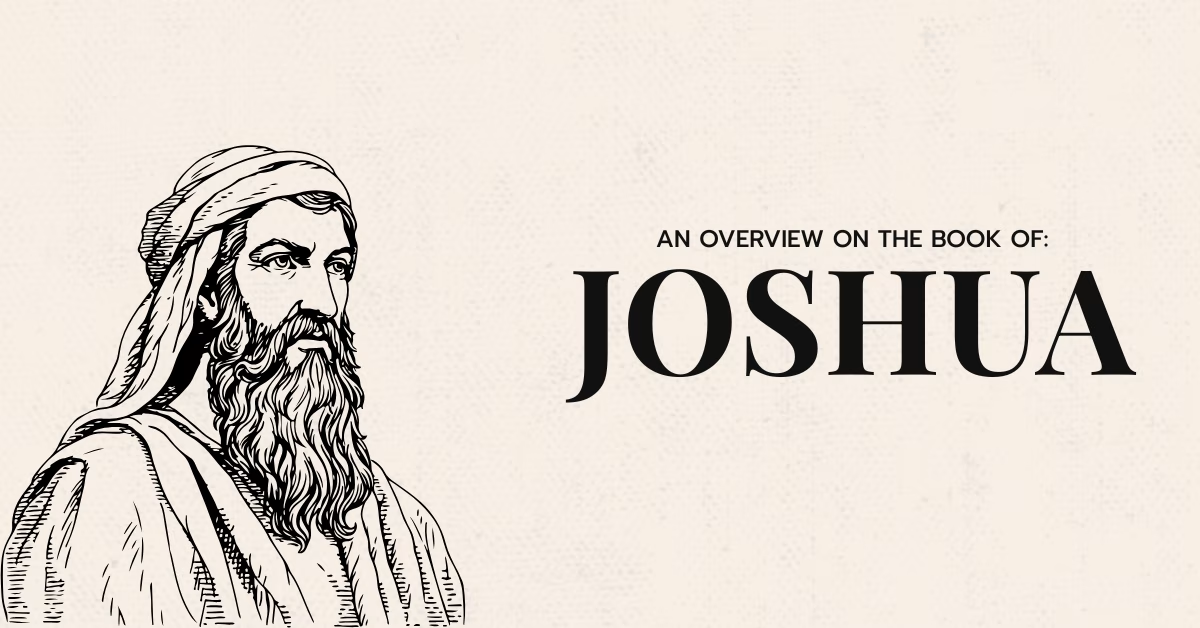
Joshua Overview
The waiting is over. Moses is gone. The Jordan River is in front of them. And God says to Joshua what He has been saying to every frightened leader since: be strong and courageous. Do not be afraid. I am with you wherever you go.
Israel crosses on dry ground. Jericho falls without a single sword swing. City after city is taken, not because Israel is powerful but because God goes before them. Rahab, a foreign woman who hid two spies and tied a scarlet cord in her window, becomes part of the lineage of the Messiah. Achan hides plunder under his tent and Israel loses a battle it should have won. The lesson lands hard: what you conceal will cost you. Joshua is the book of possession. God made the promise to Abraham. Moses carried it to the border. Joshua walks it into reality. The land is divided, the tribes are settled, and Joshua gathers everyone at Shechem for one final question: as for me and my house, we will serve the Lord. What will you choose?
The Author's Vision
Joshua writes as a man who has seen both the cost of unbelief and the reward of faith up close. He was one of the two spies who came back from Canaan with confidence when everyone else came back with fear. He watched a generation die in the wilderness for refusing to trust. Now he stands on the other side of the Jordan, holding everything that generation forfeited, and he writes with the urgency of someone who knows exactly what is at stake when God’s people stop trusting the God who brought them this far.
The Audience of Book
Joshua was written for a people who had just experienced the impossible and needed to understand what it meant. The Jordan parted. Jericho fell. The land was theirs. But possession required more than victory. It required continued faithfulness, ongoing obedience, and the daily decision to serve the God who had given them everything. The book was also written as a warning. The victories were real but so were the compromises. Not all the land was fully taken. Incomplete obedience would become a problem that the book of Judges would inherit.
Key Themes of Joshua
The Promised Land (Joshua 1-5)
God commands Joshua to be strong and lead Israel across the Jordan. They cross on dry ground, set up memorial stones, and celebrate Passover. Rahab’s faith saves her household. The battle belongs to the Lord before a single wall falls.
Achan's Sin (Joshua 6-8)
Jericho falls by God’s power alone. But Achan secretly takes what was forbidden and Israel loses at Ai. Sin concealed is a cancer in the camp. After judgment is executed, Joshua follows God’s strategy and Ai falls. Obedience restores what disobedience destroyed.
Gibeonite Deception (Joshua 9-10)
The Gibeonites trick Israel into a treaty. When five kings attack Gibeon, Joshua honours the covenant and God fights for Israel. The sun stands still. Creation itself obeys the God who commands it. Southern Canaan falls.
Gibeonite Deception (Joshua 9-10)
Joshua defeats the northern kings and the conquest is complete. The land is divided among the tribes. Caleb receives Hebron as promised, a reward for following God fully forty-five years earlier. The Levites receive cities but no territory. God is their inheritance.
Land Division (Joshua 11-19)
Cities of refuge are established for justice and mercy. The eastern tribes build an altar that nearly starts a civil war until its meaning is clarified. Unity is preserved. The tribes remain one people under one God.
Joshua's Farewell (Joshua 23-24)
Joshua gathers Israel and recounts everything God has done. He renews the covenant at Shechem and presses the nation to choose. Not someday. Today. As for me and my house, we will serve the Lord. The people commit. Joshua dies. The promise has been delivered.
What We Can Learn Form This Book
About God
- God keeps every promise He makes, no matter how long it takes to arrive.
- God fights for those who trust and obey Him, going before them into every battle.
- God is holy and takes sin seriously even when it is hidden from everyone else.
- God’s faithfulness extends to unexpected people like Rahab who turn to Him in faith.
- God honours delayed obedience, rewarding Caleb’s faithfulness forty-five years later.
About Humanity
- God keeps every promise He makes, no matter how long it takes to arrive.
- God fights for those who trust and obey Him, going before them into every battle.
- God is holy and takes sin seriously even when it is hidden from everyone else.
- God’s faithfulness extends to unexpected people like Rahab who turn to Him in faith.
- God honours delayed obedience, rewarding Caleb’s faithfulness forty-five years later.
About God’s Plan
- God keeps every promise He makes, no matter how long it takes to arrive.
- God fights for those who trust and obey Him, going before them into every battle.
- God is holy and takes sin seriously even when it is hidden from everyone else.
- God’s faithfulness extends to unexpected people like Rahab who turn to Him in faith.
- God honours delayed obedience, rewarding Caleb’s faithfulness forty-five years later.
Key Verses of Joshua
From Joshua, these verses reveal a God who commands courage, rewards faithfulness across decades, fights for His people, and calls every generation to a decisive and personal commitment to serve Him.
Reflection of Jesus From This Book
From Joshua, these verses reveal a God who commands courage, rewards faithfulness across decades, fights for His people, and calls every generation to a decisive and personal commitment to serve Him.
Joshua 1:1-9 - The Name That Saves
Matthew 1:21 – Joshua and Jesus share the same name in Hebrew: the Lord saves. As Joshua led Israel into the land, Jesus leads all who trust Him into the inheritance no enemy can take.
Joshua 2:18-21 - The Scarlet Cord
Hebrews 9:22 – Rahab’s scarlet cord in the window marked her house for salvation. It points to the blood of Christ, the only mark that shields a soul from judgment.
Joshua 3:15-17 - The Parted Jordan
Romans 6:4 – Israel passing through the Jordan on dry ground pictures baptism and the crossing from death into new life that Christ makes possible for all who follow Him.
Joshua 5:13-15 - The Commander of the Lord's Army
Revelation 19:11-16 – The divine warrior who appears to Joshua before Jericho falls points to Christ, the conquering King who leads His people to final and total victory.
Joshua 6:20 - Walls That Fall
Ephesians 2:14 – The walls of Jericho fell by God’s power alone. Christ breaks down every wall of hostility, including the greatest wall of all, the one between humanity and God.
Joshua 21:45 - Every Promise Kept
2 Corinthians 1:20 – Not one good word of God failed in Joshua’s day. In Christ, every promise of God finds its yes and amen, confirmed and delivered in full.
Joshua declares that the God who gave Israel the land is the same God who, in Christ, gives every believer an inheritance that cannot be lost, stolen, or taken away.
Practical Applications for This Book
- Step into the river before it parts – God parted the Jordan only after the priests’ feet touched the water. Courage comes after the first step, not before it.
- Deal with hidden sin quickly – Achan’s secret cost the whole community. What you conceal does not stay contained. Bring it to light before it surfaces on its own.
- Build memorials of remembrance – Israel stacked twelve stones at the Jordan. Mark what God does in your life so you and your children can point to it later.
- Honour your commitments even when they cost you – Israel kept the treaty with Gibeon even though it was obtained by deception. Your word is your integrity. Keep it.
- Make the declaration out loud – Joshua did not just decide privately. He said it publicly: as for me and my house, we will serve the Lord. Say it. Mean it. Live it.
"God does not just promise the land. He walks you into it one step at a time."
Joshua is the sound of a promise finally becoming a place.
Abraham heard it. Isaac carried it. Jacob held it at a distance. Moses brought a generation to the edge of it. And now Joshua crosses. The Jordan parts. The walls fall. The land is real and it is theirs. Everything God said to one man in Ur of the Chaldeans is now soil under their feet.
This is what God does with His promises. He is never in a hurry and He is never late. Whatever He has spoken over your life is still standing. The Jordan is not the end of the journey. It is where the promise becomes real.
3 Stories of This Book
Reflection on Joshua
“Be strong and of good courage; do not be afraid, nor be dismayed, for the Lord your God is with you wherever you go.” – Joshua 1:9
Maybe you are standing at your own Jordan right now.
Not a river. The kind of obstacle that looks impossible from where you are standing. The kind that makes you wonder if the promise on the other side was ever really meant for you. It is wide. It is deep. And it is not moving.
God does not ask you to figure out how to cross it. He asks you to step in. The priests did not know when the water would stop. They just put their feet in. And the moment they did, the river opened.
That is still how it works. The parting comes after the step, not before it. Courage is not the absence of fear. It is moving forward anyway because you trust the One who told you to go.
Whatever is in front of you today, step in. The God who parted the Jordan is the same God who goes before you now.
How Joshua Connects to The Rest of Scripture
Joshua is the hinge between the promises of the Pentateuch and the story of Israel living in the land, and its themes run deep through both Testaments.
- The name Joshua is the name Jesus in Hebrew – Both mean the Lord saves. As Joshua led Israel into the Promised Land, Jesus leads all who trust Him into the eternal inheritance God has prepared.
- Rahab appears in the genealogy of Jesus in Matthew 1 – Her inclusion is not incidental. It declares from the very first page of the New Testament that God’s grace has always crossed every human boundary.
- The rest Israel finds in the land is quoted in Hebrews 4 – The writer of Hebrews uses Joshua’s rest as a picture of the deeper rest that remains for the people of God, fully available only in Christ.
- Every promise kept in Joshua 21:45 grounds the New Testament’s confidence – Paul’s declaration that all God’s promises find their yes in Christ stands on the same foundation: this God does not fail to deliver what He has spoken.
When you understand Joshua, you understand that God’s promises are not wishful thinking. They are a territory He intends to give you, and He has already gone ahead to prepare the way.
Living Joshua in Action
Identify one place where God has spoken a promise over your life that you have not yet stepped toward. Choose one action this week that moves you closer to it.
“Be strong and of good courage; do not be afraid, nor be dismayed, for the Lord your God is with you wherever you go.” – Joshua 1:9
The God who parted the Jordan for Joshua goes before you into every impossible place.
You've Just Taken Your First Step.
Joshua is Book 6 of 66. Each one has something to say to you.
The same God who kept every promise to Israel keeps every promise to you.
Keep stepping. Keep trusting. The walls are already falling.