Ruth Overview
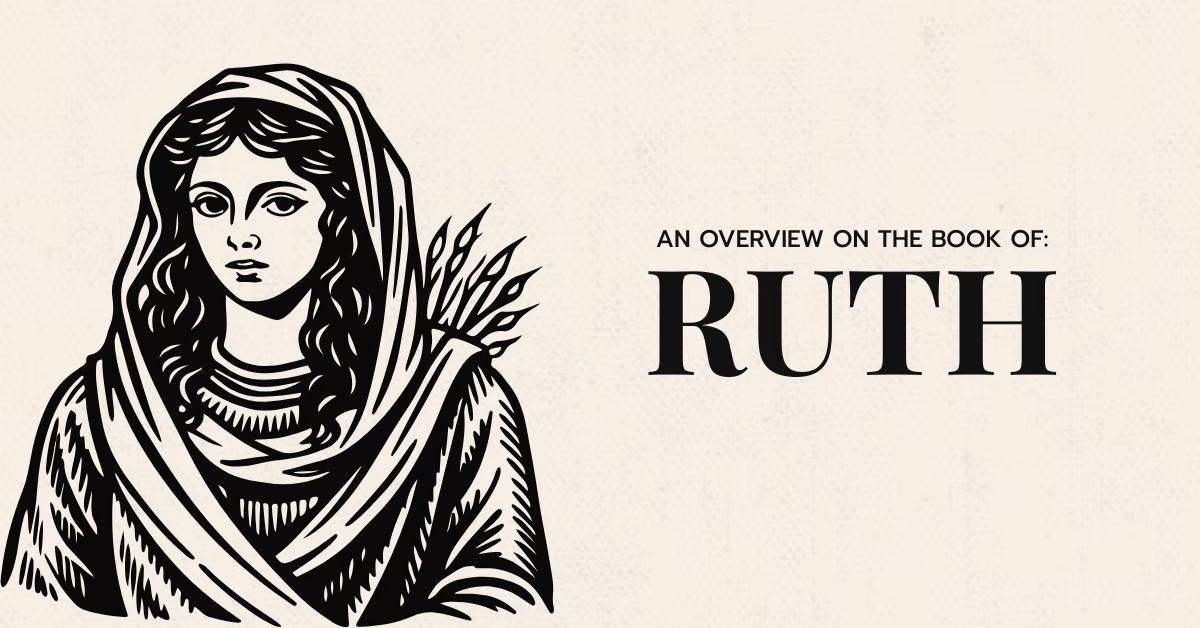
The world of Judges is still burning in the background. But inside that darkness, a small story is unfolding in a barley field outside Bethlehem. A Moabite widow. An old woman full of bitterness. A kind man who notices what others walk past. And a God who is quietly threading everything together.
Elimelech takes his family from Bethlehem to Moab to escape a famine. He dies there. His two sons marry Moabite women and then they die too. Naomi is left with nothing – no husband, no sons, no future. She tells her daughters-in-law to go home to their own people and their own gods. Orpah goes. Ruth refuses.
What follows is one of the most quietly beautiful stories in all of Scripture. Ruth gleans in a field. The field belongs to Boaz. Boaz notices her loyalty to Naomi and becomes her kinsman-redeemer. From their union comes a son named Obed, who becomes the father of Jesse, who becomes the father of David. The woman with nothing becomes the great-grandmother of a king, and a distant ancestor of the King of kings.
The Author's Vision
The author writes with remarkable tenderness. There is no battle in Ruth, no miracle that splits a sea or brings fire from heaven. The supernatural is entirely invisible – and entirely present. God is nowhere named as acting directly in the story, yet His hand is woven through every scene. The author’s point is gentle but unmistakable: faithfulness in small things is never wasted. A foreign woman’s decision to stay with her mother-in-law on a dusty road outside Moab ends up in the genealogy of the Messiah. Nothing done in loyalty to God is too small to matter.
The Audience of Book
Ruth was written for a people who needed to see that God does not only work through armies and prophets and great national events. He works through a widow’s loyalty. Through a farmer’s kindness. Through a quiet conversation at a threshing floor. The original audience, living through the chaos of the judges period, needed to know that God had not abandoned them to the large and noisy history. He was present in the small and faithful moments too.
Key Themes of Ruth
Ruth's Loyalty to Naomi (Ruth 1)
Naomi loses everything and tells Ruth to go back to her own people and gods. Ruth refuses with one of the most beautiful declarations of loyalty in Scripture. Where you go I will go. Your people shall be my people. Your God my God. Loyalty is a choice, not a feeling. Ruth makes the choice when it costs her the most.
Ruth in Boaz's Field (Ruth 2)
Ruth goes to glean in the fields, the provision God built into the law for the poor and the foreigner. She ends up in Boaz’s field. Not by accident. Boaz notices her faithfulness to Naomi, protects her among the workers, and tells them to leave extra grain. Ordinary kindness is often God’s provision wearing everyday clothes.
Request for Redemption (Ruth 3)
Naomi instructs Ruth to approach Boaz at the threshing floor and ask him to spread his covering over her as her nearest kinsman. It is a request for redemption under the law. Boaz responds with honour. He will pursue the right through proper legal channels. Ruth returns to Naomi not empty but full.
Request for Redemption (Ruth 3)
At the city gate before the elders, Boaz settles the legal question with the nearer relative who declines to act as redeemer. Boaz takes Ruth as his wife. The elders pronounce blessing. What began in grief is resolving into grace. The transaction is complete and a new family is formed.
Boaz Marries Ruth (Ruth 4:1-12)
God gives Ruth and Boaz a son. The women of Bethlehem name him Obed and celebrate Naomi, who went out full and came back empty and is now holding a grandson. What Naomi called bitter, God is calling blessed. He has not left her without a redeemer. He never left her at all.
Ruth's Lineage to David (Ruth 4:18-22)
The book closes with a genealogy that would have stopped readers in their tracks. From Perez to Obed to Jesse to David. The foreign widow’s child is in the royal line. Ruth’s loyalty on a dusty road outside Moab has carried into the throne room of Israel, and further still, into the coming of the King.
What We Can Learn Form This Book
About God
- God works through ordinary people making faithful choices in unremarkable circumstances.
- God’s provision often arrives through the kindness of another person, not from the sky.
- God does not restrict His redemptive plan to one nation – Ruth is a Moabite welcomed into covenant.
- God restores what was lost, often through paths that do not look like restoration while they are happening.
- God’s timing is not slow – it is exact, and it is always building toward something beyond what we can see.
About Humanity
- True loyalty is demonstrated in the moment when leaving would be easier and more reasonable.
- Small faithful choices carry more eternal weight than they appear to carry in the moment.
- Bitterness is an honest response to real loss, but it is not the final word God writes over our story.
- Kindness to the vulnerable and the foreign is not exceptional – it is what faithfulness to God looks like in ordinary life.
- Our greatest moments are often hidden in the routine of working, waiting, and trusting quietly.
About God’s Plan
- The kinsman-redeemer law embedded in Israel’s covenant was always pointing toward the ultimate Redeemer.
- God’s plan includes the nations from the beginning – a Moabite widow belongs in the genealogy of the Messiah.
- The thread from Ruth to David to Jesus is not coincidence but providence woven through faithful ordinary lives.
- Redemption always involves someone willing to pay the price to restore what was lost.
- The story of Ruth shows that God’s plan advances not only through spectacular events but through daily faithfulness.
Key Verses of Ruth
From Ruth, these verses reveal that loyalty, redemption, and restoration are woven into the fabric of ordinary days, assuring us that God is present and purposeful in every season of loss, waiting, and quiet faithfulness.
Reflection of Jesus From This Book
Ruth is one of the most concentrated foreshadowings of Christ in the entire Old Testament, every element of the kinsman-redeemer story pointing with remarkable precision to the One who would pay the full price to restore what humanity had lost.
Ruth 2:12 - The Refuge Under Wings
Matthew 23:37 – Boaz blesses Ruth for sheltering under God’s wings. Jesus weeps over Jerusalem longing to gather her children as a hen gathers her chicks, offering the same refuge to all who come to Him.
Ruth 3:9 - The Kinsman Who Covers
Galatians 4:4-5 – Ruth asks Boaz to spread his covering over her as her nearest kinsman. Christ, born under the law, came as our nearest kinsman to cover our debt and bring us into His family as adopted heirs.
Ruth 4:1-10 - The Redeemer Who Pays the Price
1 Peter 1:18-19 – Boaz redeems Ruth’s inheritance at personal cost, refusing to let a nearer relative take his place. Christ redeems us at the ultimate cost, the only One qualified and willing to pay the full price.
Ruth 4:13 - Life from the Barren
Romans 4:17 – God opens Ruth’s womb and gives new life where there was loss. Christ gives spiritual life to those who were dead, making the barren fruitful by His grace.
Ruth 4:17-22 - The Outsider in the Royal Line
Galatians 3:28-29 – A Moabite widow becomes an ancestor of David and ultimately of Christ, declaring that in God’s redemptive plan there is no distinction of nation. Every person who comes to Christ enters the royal lineage by faith.
Ruth 4:9–10 – The Public Declaration of Redemption
Hebrews 2:11–12 – Boaz publicly declares his redemption of Ruth before the elders. Christ openly calls the redeemed His brothers and sisters, bringing them into God’s family.
Galatians 3:28-29 – A Moabite widow becomes an ancestor of David and ultimately of Christ, declaring that in God’s redemptive plan there is no distinction of nation. Every person who comes to Christ enters the royal lineage by faith.
Practical Applications for This Book
- Choose loyalty when it costs you – Ruth’s defining moment came when leaving was easy and staying was hard. That is always when real loyalty is revealed.
- Work faithfully in the field you have been given – Ruth did not wait for a better field. She worked hard in the one she found herself in. God met her there.
- Show up for the grieving – Boaz noticed Ruth. He created extra provision without being asked. Someone near you is gleaning at the edges. Look for them.
- Trust the quiet seasons – Nothing miraculous happened in the barley field. Just work, kindness, and time. God was building something Ruth could not yet see.
- Receive redemption without shame – Ruth approached Boaz with her need openly and without apology. The Redeemer is not waiting for you to need less. He is waiting for you to come.
"Your people shall be my people, and your God my God."
Ruth is the sound of a door closing on everything familiar and a woman walking forward anyway because love made the choice before reason could object.
The harvest fields are ordinary. The conversations are quiet. No armies march through this book. But something eternal is moving beneath every scene. A foreign widow’s faithfulness is being woven without her knowledge into the fabric of the coming King.
God does not need the dramatic to do the eternal. He needs the faithful. And He is weaving your ordinary days into something you cannot yet see.
3 Stories of This Book
Reflection on Ruth
“Where you go, I will go, and where you lodge, I will lodge. Your people shall be my people, and your God, my God.” – Ruth 1:16
Maybe you are standing at a crossroads where the easier path is clearly marked.
Going back is not cowardice. It is reasonable. The road ahead is uncertain and the cost is real and no one would blame you for turning around.
But something in you is not moving. Because somewhere beneath the fear and the grief and the reasonable arguments, there is a quiet knowing that this is where you belong. With these people. With this God. In this field.
Ruth did not stay because it made sense. She stayed because she had chosen. And God met her exactly where she planted her feet.
Take your next step. Stay in the field. The harvest is coming, and you are already in the right place.
How Ruth Connects to The Rest of Scripture
Ruth is the quiet bridge between the chaos of the judges and the glory of the Davidic kingdom, and its themes of loyalty, redemption, and inclusion run like threads through the entire Bible.
- The kinsman-redeemer law from Leviticus 25 finds its most vivid narrative expression in Ruth – Boaz doing what the law required becomes the human picture of what Christ would fulfil completely.
- Ruth appears by name in the genealogy of Jesus in Matthew 1 – The foreign widow is listed alongside Abraham and David in the opening verses of the New Testament, declaring that God’s redemptive plan was always for all nations.
- Naomi’s restoration echoes the pattern of Job – Loss followed by waiting followed by restoration beyond what was taken. It is one of Scripture’s recurring declarations about the nature of God.
- The book anticipates Pentecost – The Spirit is not mentioned in Ruth, yet the fruit of the Spirit is visible in every chapter. Loyalty, kindness, patience, faithfulness. The life that the Spirit produces was lived here before He was poured out.
When you understand Ruth, you understand that God’s grace has always been wider than any border, that redemption has always required a willing kinsman, and that the most important moments in God’s story are often the ones that look the most ordinary.
Living Ruth in Action
Is there a relationship, a commitment, or a calling you have been tempted to walk away from? Something that once felt clear but now just feels costly?
“Where you go, I will go. Your people shall be my people, and your God, my God.” – Ruth 1:16
Ruth stayed in the field. God met her there.
You've Just Taken Your First Step.
Ruth is Book 8 of 66. Each one has something to say to you.
The same God who redeemed Ruth out of loss and obscurity is redeeming your story right now.
Keep showing up. Keep gleaning. The harvest belongs to the faithful.