Exodus Overview
A burning bush that does not burn up. A stuttering shepherd who ran from his past. God is about to step into history in a way no one has seen since creation, and He is choosing the most unlikely man to lead it.
Exodus is the story of a nation born out of slavery. Four hundred years of silence end when God sends ten plagues through Egypt’s empire. A lamb is slain, blood marks the doorposts, death passes over. The Red Sea opens, an army drowns, and a people walk out on dry ground.
But freedom is more than leaving Egypt behind. At Sinai, God gives His law, calls Israel into covenant, and fills a tabernacle with His glory. The same God who parted the sea now wants to live among His people. Exodus is not just a rescue. It is an invitation.
The Author's Vision
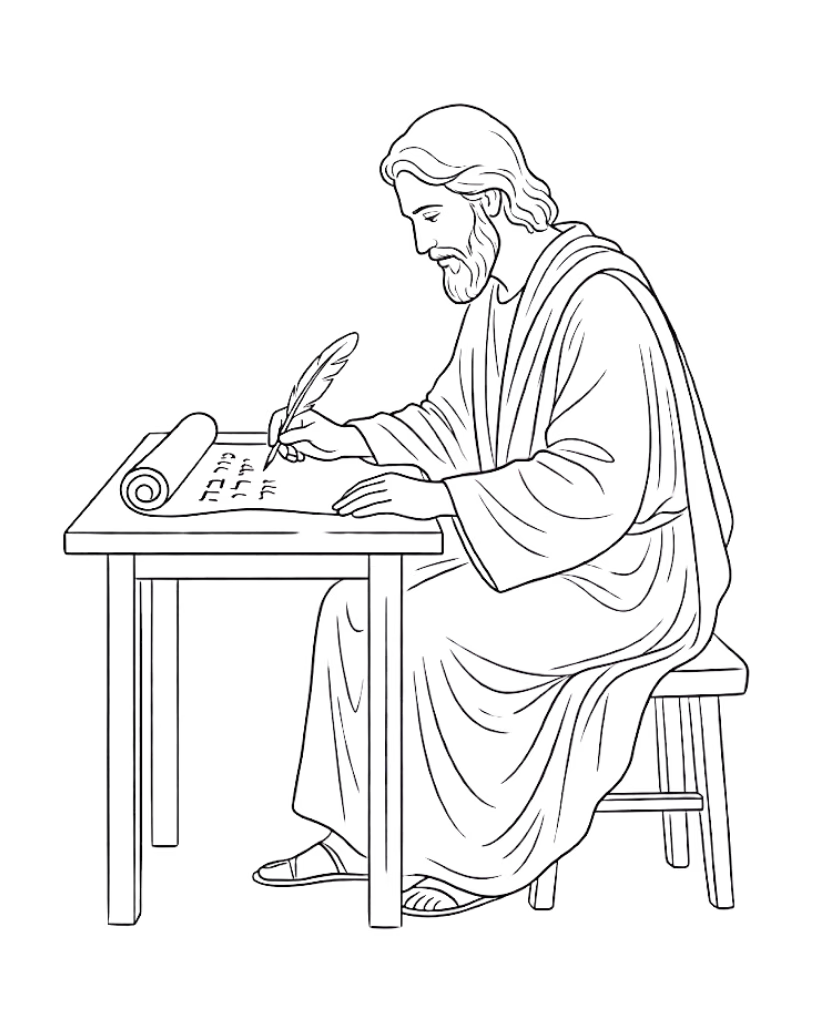
Moses wrote Exodus from the inside. This was his story too. The burning bush, the plagues, the crossing, Sinai. He was not writing as an observer but as a participant, and that gives the book a weight that shows on every page. He wanted his people to know that the God who freed them would also sustain them ahead. That their covenant was not a burden but a mercy. That belonging to God meant something in how they worshipped, how they treated one another, and how they lived every ordinary day.
The Audience of Book
Exodus was written for the same audience as Genesis, the nation of Israel. But now they were not just learning where they came from. They were standing in the wilderness, freshly delivered from four hundred years of bondage, with no map and no country to call their own. They needed to understand that God had specifically chosen them, fought for them, and was calling them into covenant. Exodus told them who they were, whose they were, and how that was supposed to change everything about how they lived.
Key Themes of Exodus
Birth of Moses (1-2)
A new Pharaoh rises who does not remember Joseph, and fear turns to oppression. A mother places her baby in a basket on the river. God protects what Pharaoh tries to destroy, raising Moses inside the very palace that enslaves his people.
Moses' Call and Plagues (3-12)
God speaks from a burning bush and sends a reluctant shepherd back to the empire he fled. Ten plagues move through Egypt like a verdict. Where blood covers the doorpost, death passes over. The Passover is not just a rescue. It is a picture of everything coming.
Red Sea Crossing and Wilderness Tests (13-18)
With the sea ahead and an army behind, God opens the water. They walk through on dry ground. The wilderness that follows tests everything. Water, hunger, enemies. God provides anyway, teaching a people who only knew slavery what it means to trust.
Red Sea Crossing and Wilderness Tests (13-18)
At Sinai, God descends in fire and smoke and speaks. Out of that holy encounter comes the law, not as a cage but as a covenant. The Ten Commandments shape a people who had spent centuries shaped by slavery.
Ten Commandments (19-24)
God gives detailed instructions for a portable sanctuary to travel with Israel. Every measurement, every material matters. This is not merely architecture. It is theology in three dimensions. The God of the universe is making a place to live among His people.
The Golden Calf (32-40)
While Moses is on the mountain, Israel builds a golden calf below. The covenant breaks almost as soon as it is made. God’s mercy holds. The covenant is renewed. Exodus ends where it always meant to arrive, with God dwelling among His people.
What We Can Learn Form This Book
About God
- God hears the cries of suffering people and acts.
- God is more powerful than any earthly authority.
- God is holy and cannot be approached carelessly.
- God keeps His covenant even when people break theirs.
- God desires to dwell among His people, not only above them.
About Humanity
- God hears the cries of suffering people and acts.
- God is more powerful than any earthly authority.
- God is holy and cannot be approached carelessly.
- God keeps His covenant even when people break theirs.
- God desires to dwell among His people, not only above them.
About God’s Plan
- Redemption follows a pattern: bondage, deliverance, covenant, dwelling.
- The Passover lamb points to the ultimate sacrifice.
- The law is grace’s framework, not its enemy.
- God’s plan always moves toward nearness.
- Sinai sets the stage for everything that follows.
Key Verses of Exodus
From the Book of Exodus, these verses reveal God as deliverer, lawgiver, and dwelling presence, assuring us that He fights for His people, calls them His own, and commits to go with them through every wilderness.
Reflection of Jesus From This Book
From the very first plague to the glory filling the tabernacle, Exodus is saturated with the shape of what Christ would one day come to do, fully and finally.
Exodus 12:13 - The Passover Lamb
1 Corinthians 5:7 – Christ is our Passover, sacrificed for us. The blood on the doorposts is the clearest early picture of what His blood would accomplish on the cross.
Exodus 14:21–22 - The Red Sea Crossing
1 Corinthians 10:1–2 – As Israel passed through the sea into new life, baptism marks our passage from death into freedom through Christ.
Exodus 16:15 - Manna in the Wilderness
John 6:35 – Jesus declared Himself the true Bread from heaven, the one who sustains His people not just for a day but forever.
Exodus 17:6 - Water from the Rock
1 Corinthians 10:4 – That rock was Christ. The living water He gives does not run dry.
Exodus 25:8 - The Tabernacle
John 1:14 – The Word became flesh and tabernacled among us. God’s desire to dwell with His people found its ultimate expression in the incarnation.
Exodus 33:11 - Moses as Mediator
1 Timothy 2:5 – Moses stood between God and the people, but Jesus is the one Mediator between God and man, fully and permanently.
God has faithfully fulfilled His redemptive promises through Christ’s life, death, and resurrection, and continues accomplishing His saving purposes today.
Practical Applications for This Book
- You are not defined by what enslaved you – Pharaoh named Israel. God renamed them. God’s call reaches further than whatever held you.
- Trust God in the wilderness, not just at the sea – The miracle gets remembered. The manna gets forgotten. Both are God.
- Do not build golden calves while you wait – Impatience pushes toward substitutes. Waiting is not empty time.
- The law is a gift, not a burden – The Commandments were given to rescued people to live freedom well.
- God wants to be near you – The tabernacle was built for Israel’s sake, not God’s comfort. He came down. He still does.
God does not just open the sea. He moves in next door.
Exodus is the sound of chains hitting the ground.
It is plagues and parted water and a mountain on fire. But underneath all of that is one quiet, staggering idea. The God who freed an entire nation from the most powerful empire on earth wanted, more than anything, to live in the middle of their camp.
Not above them. Not ahead of them. Among them. Every chapter moves toward that moment. Every detail of the tabernacle exists to say one thing: I am here.
3 Stories of This Book
Reflection on Exodus
“The LORD said, I have indeed seen the misery of my people in Egypt. I have heard them crying out and I am concerned about their suffering.” – Exodus 3:7
Maybe you have been in your own Egypt for longer than you want to admit.
Not a country. A job, a relationship, a pattern, a version of yourself you cannot seem to leave behind. You have been making bricks for something that was never meant to own you.
And then God speaks. Not from a palace but from a burning bush on an ordinary hillside. And He says three things that change everything.
I have seen. I have heard. I am concerned.
He is saying that to you right now.
Whatever you are carrying that feels too ordinary for a miracle, too long-running for hope, He sees it. He has not looked away. He has not decided your situation is too far gone.
The bush burned and was not consumed. You may be in the fire right now and somehow still standing. God is not alarmed by the flame. He is speaking inside it.
How Exodus Connects to The Rest of Scripture
Exodus is the central redemptive event of the Old Testament. Almost everything that follows refers back to it.
- The Passover becomes the framework for the cross. Paul calls Christ “our Passover Lamb” (1 Corinthians 5:7). The Last Supper is a Passover meal.
- The wilderness journey echoes through the Psalms, Prophets, and New Testament. Jesus spends 40 days in the wilderness, mirroring Israel’s 40 years.
- The tabernacle points to Christ, in whom all the fullness of God dwells bodily (Colossians 2:9). Every detail of the tent points to Him.
- Moses as a type of Christ is one of the clearest prophetic patterns in Scripture. A deliverer, a mediator, a lawgiver. Jesus is all three, only greater.
When you read Exodus, you are reading the vocabulary the rest of the Bible will speak for the next fifteen hundred years.
Living Exodus in Action
Think of one thing in your life right now where you keep trying to force the outcome.
Write this beside it:
“The LORD will fight for you. You need only to be still.” – Exodus 14:14
The sea was not Israel’s problem to solve. And neither is yours.
You've Just Taken Your First Step.
Exodus is Book 2 of 66. Each one has something to say to you.
The same God who opened the sea and descended on the mountain is at work in your story right now.
Keep reading. Keep showing up. Keep trusting the One who came down.