Judges Overview
Joshua is dead. The land is taken but not held. And almost immediately, Israel begins to forget. They do not drive out the remaining Canaanites. They adopt their gods. And one of the most tragic cycles in all of Scripture begins to turn.
The pattern repeats itself thirteen times. Israel sins. Enemies rise. The people cry out. God raises a judge. Deliverance comes. Then the judge dies, and the cycle begins again. Othniel. Ehud. Deborah. Gideon. Jephthah. Samson. Each one a flash of God’s mercy into a darkness that keeps returning.
The book ends with no resolution, only a diagnosis. There was no king in Israel. Everyone did what was right in his own eyes. Judges is not a story of Israel’s failure alone. It is a mirror held up to every human heart that keeps returning to the same broken patterns and keeps needing the same patient God to come and rescue it again.
The Author's Vision
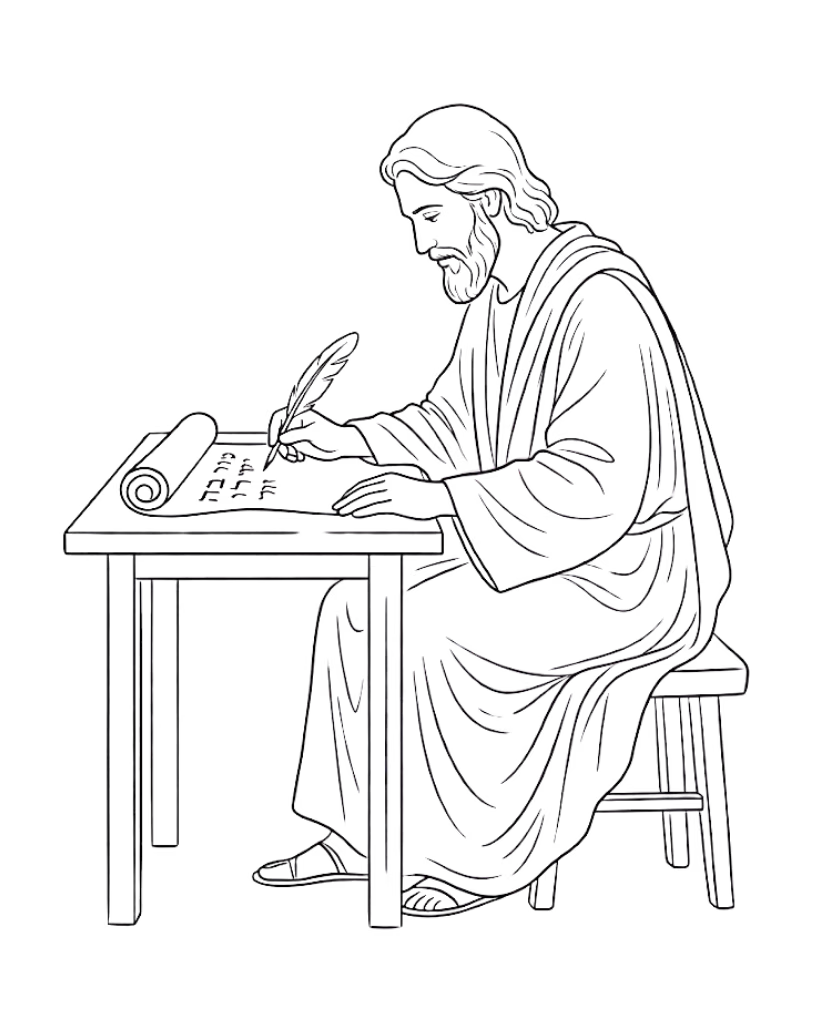
The author writes as someone watching a tragedy unfold in slow motion, seeing the same mistakes repeated with each generation. There is grief in the writing but also unflinching honesty. The judges are not presented as heroes. They are broken instruments. Gideon ends in idolatry. Jephthah makes a rash vow that destroys his daughter. Samson wastes his calling on personal vendettas and a woman who betrays him. The author’s point is unmistakable: flawed deliverers can never permanently fix what is broken in the human heart. Israel needs more than a judge. It needs a king.
The Audience of Book
Judges was written for a people who needed to understand why everything had gone so wrong so quickly. They had the land. They had the law. They had witnessed God’s power in Joshua’s generation. And yet within a single generation, the pattern of rebellion had already begun. The book was a call to remember that the problem was never the enemies outside Israel. The problem was always the drift inside Israel. The same drift that every generation is susceptible to the moment it stops deliberately choosing God.
Key Themes of Judges
The First Judges (Judges 1-3)
Israel fails to drive out the Canaanites and the cycle begins. God raises Othniel, Ehud, and Shamgar as the first deliverers. The Spirit of the Lord empowers each one. But every victory is followed by a return to the same failure that made the rescue necessary.
Judges Call (Judges 4-6)
Deborah leads Israel to victory alongside Barak, and Jael finishes the enemy commander with a tent peg. Then God calls Gideon, a frightened farmer hiding from the Midianites, and calls him a mighty man of valour. Gideon asks for signs and God gives them, meeting fear with patience.
Gideon's Victory (Judges 7-11)
Three hundred men with torches and jars defeat the entire Midianite army. Victory belongs to God, not numbers. But after Gideon’s death, his son Abimelech seizes power brutally. Jephthah defeats Ammon but keeps a rash vow at devastating personal cost. The cycle never fully breaks.
Gideon's Victory (Judges 7-11)
Born under a divine vow, set apart from birth, gifted with supernatural strength. And yet Samson spends his calling on private grudges and forbidden relationships. Delilah delivers him to his enemies. Blinded and imprisoned, he dies pulling down the Philistine temple, killing more in his death than in his life.
Samson (Judges 12-16)
The final chapters strip away any remaining pretense. Idolatry spreads through the tribe of Dan. A Levite’s concubine is murdered in a scene that echoes the darkest wickedness of Sodom. The nation is unraveling from the inside. The phrase returns: everyone did what was right in his own eyes.
Need for a King (Judges 20-21)
Civil war erupts against the tribe of Benjamin. The slaughter is catastrophic. The book ends not with resolution but with the raw declaration of its own diagnosis. There is no king. And without a king, everything falls apart.
What We Can Learn Form This Book
About God
- God is extraordinarily patient with repeated failure, returning to rescue even when the cycle has turned many times.
- God raises up deliverers from the most unlikely places and the most unlikely people.
- God empowers through His Spirit, not through human strength, talent, or size.
- God disciplines His people through consequence, never abandoning His covenant even in the worst seasons.
- God’s mercy is not a license for continued rebellion but an invitation back to faithfulness.
About Humanity
- We forget God’s faithfulness faster than we experienced it, especially when life becomes comfortable.
- Partial obedience always leaves enemies in the territory that will cause trouble later.
- Our greatest strengths can become our greatest vulnerabilities when not surrendered to God.
- Cycles of sin are broken not by willpower but by genuine turning back to God.
- A generation that does not deliberately pass on faith will raise a generation that does not know God.
About God’s Plan
- We forget God’s faithfulness faster than we experienced it, especially when life becomes comfortable.
- Partial obedience always leaves enemies in the territory that will cause trouble later.
- Our greatest strengths can become our greatest vulnerabilities when not surrendered to God.
- Cycles of sin are broken not by willpower but by genuine turning back to God.
- A generation that does not deliberately pass on faith will raise a generation that does not know God.
Key Verses of Judges
From Judges, these verses reveal a God whose patience outlasts every cycle of human failure, who empowers the weak, hears the desperate cry, and whose mercy is the only thing standing between Israel and total collapse.
Reflection of Jesus From This Book
Judges exposes the desperate need for a deliverer who does not fail, a judge who does not drift, and a king whose reign never ends, and every flawed hero in the book points toward the One who is all three.
Judges 2:16 - The Raised-Up Deliverer
Acts 5:31 – Every judge God raises is a shadow of Christ, the ultimate Deliverer whom God raised up to rescue not one nation from one enemy but all humanity from sin and death.
Judges 6:34 - The Spirit Empowered Leader
Luke 4:18 – The Spirit rushing upon the judges to empower them for deliverance points to Christ, anointed by the Spirit at His baptism for the greater work of redemption.
Judges 13:5 - The Set-Apart Deliverer
Luke 1:35 – Samson was set apart from birth under a Nazirite vow. Jesus was set apart from conception by the Holy Spirit, the perfect and permanent deliverer Samson could only shadow.
Judges 16:29-30 - Arms Outstretched
John 19:30 – Samson’s arms outstretched between the pillars, bringing down the enemy through his own death, points unmistakably to Christ whose outstretched arms on the cross achieved the final and total victory over all enemies.
Judges 17:6 - The Need for a King
Revelation 19:16 – The dark refrain of Judges is answered in Christ, the King of kings whose reign finally ends the cycle of doing what is right in one’s own eyes and establishes a kingdom of righteousness that cannot fall.
Judges 19:1 – No King in Israel
John 18:37 – Jesus declares Himself the true King who came to testify to the truth, the righteous ruler Israel truly needed.
Judges declares that human deliverers, no matter how gifted, will always fall short. The cycle will not end until the perfect Judge and King arrives, and in Christ, it has.
Practical Applications for This Book
- Identify your cycle – The pattern in Judges is drift, consequence, cry, rescue, drift again. Name honestly where you are in that cycle right now.
- Drive out what you tolerate – Israel left enemies in the land and paid for it for generations. Small compromises left in place always cost more than the effort to remove them.
- Let God rename you – Gideon felt like a coward. God called him mighty. What God says about you is truer than what fear says about you.
- Guard the generation behind you – The generation that forgot God did not rise from nowhere. Someone stopped telling the story. Keep telling it.
- Cry out before the crisis hits – Israel always cried out after the oppression began. God is not waiting for the worst moment. He is available now.
"God does not stop being merciful just because the cycle has turned again."
Judges is the sound of a people forgetting, falling, and crying out, over and over, and a God who keeps showing up anyway.
Thirteen times the pattern turns. Thirteen times God could have said: enough. He never does. He raises another judge. He sends the Spirit again. He hears the cry that sounds exactly like the last one and answers it like it is the first.
That is the God of Judges. And He is still the same God you are crying out to today.
3 Stories of This Book
Reflection on Judges
“Nevertheless, the Lord raised up judges who delivered them out of the hand of those who plundered them.” – Judges 2:16
Maybe you are in the cycle again.
Not for the first time. You know this place. You have been rescued from it before. And somehow you are back, and the shame of being back makes it harder to cry out than it was the first time.
God is not keeping score the way you are. He is not comparing this cry to the last one.
He raised up a deliverer for Israel the second time. And the third. And the thirteenth. Not because they had earned another rescue, but because that is who He is.
You have not used up your place in His mercy. The same God who answered then is here now. Cry out. He is already moving.
How Judges Connects to The Rest of Scripture
Judges is the dark hinge between the promise of the Promised Land and the long road toward the kingdom, and its core cry for a righteous king echoes through every book that follows.
- The refrain “no king in Israel” is answered directly in 1 Samuel – Israel’s demand for a king begins the monarchy, which in turn points toward the one true King whose kingdom will have no end.
- Samson’s death with arms outstretched between the pillars is one of the most discussed foreshadowings of the crucifixion in the Old Testament – Victory through the deliverer’s own death is the pattern Christ fulfills perfectly.
- The Spirit rushing upon the judges foreshadows Pentecost – The empowerment that came and went for each judge becomes the permanent indwelling promised to all who belong to Christ.
- Paul’s warning in Romans 1 that God gives people over to what they choose echoes the structure of Judges – The consequences Israel faced were not punishments dropped from outside. They were the natural fruit of what Israel had chosen.
When you understand Judges, you understand why the world cannot fix itself, why human leadership always falls short, and why the only lasting answer is a King who does not drift, does not fail, and does not die.
Living Judges in Action
Identify one cycle in your life that keeps returning. One area where you have been delivered before and drifted back. Bring it to God this week, not with shame, but with honesty.
“Nevertheless, the Lord raised up judges who delivered them.” – Judges 2:16
The God who kept showing up for Israel keeps showing up for you.
You've Just Taken Your First Step.
Judges is Book 7 of 66. Each one has something to say to you.
The same God who answered the cry of a people in their worst cycles answers yours.
Keep crying out. Keep returning. His mercy has not run out.